
Oman Family Road Trip: 2 Weeks from Mountains to Desert to Sea
Two weeks driving across Oman with the family over the holidays: ancient forts, desert camps, turquoise wadis, and one of the most stunning mosques on Earth.

Oman was nowhere near our radar until a friend mentioned it as "the Middle East you can road trip with kids." We looked into it, compare flights, rented an SUV, and spent the last two weeks of December 2022 driving a loop through the country's interior. Mountains, desert, wadis, coast, and one of the most beautiful mosques in the world — all in one trip, all with a 9-year-old and a 13-year-old in the back seat.
What we did not expect: how easy the country makes itself for families. We covered roughly 1,200 kilometres in 12 days — 21 December 2022 to 1 January 2023 — without a single drive exceeding three hours, on roads that are uniformly excellent, with petrol at about a third of French prices. The sequence went mountains (Bahlā', Jebel Akhdar, Nizwá) → desert (Wahiba Sands on Christmas Eve) → wadis (Tiwi and Shab on the east coast) → Muscat and the Sultan Qaboos Grand Mosque on New Year's Day. What follows is how that actually played out, with the hours and altitudes that mattered and what we'd redo differently.
Bookings: Some of the links in this article are affiliate links. This means that if you choose to make a booking, we will receive a small commission at no extra cost to you. Thank You!
Why Oman?
Most people considering the Middle East default to Dubai or Abu Dhabi. Oman is a different proposition entirely. There are no skyscrapers competing for attention, no artificial islands, no theme parks. What there is: raw, dramatic nature on a scale that's hard to comprehend until you're standing in it. Mountains that drop 2,000 metres into canyons. A desert that stretches to the horizon in every direction. Wadis — river canyons — where you swim through turquoise pools between towering rock walls. And a culture that's been quietly welcoming travellers for centuries without turning itself into a caricature.
For families, Oman hits a practical sweet spot. Our kids (9 and 13 at the time) spent the two weeks riding a camel at Wahiba camp, swimming in wadi pools that ranged from chest-deep to proper scramble-and-rope-swing territory, and exploring UNESCO forts — all on infrastructure that felt closer to southern Europe than the Middle Eastern cliché. Roads are modern and well-signposted, accommodation ranges from a mid-range Bedouin camp in the dunes to a beach resort east of Muscat, and the Omanis we dealt with — camp staff, souk vendors, fort guides — treated the kids with a warmth that was the quiet surprise of the trip.
The country also works brilliantly as a road trip. A two-week loop starting and ending in Muscat covers all the major regions without any single drive exceeding three hours. We covered roughly 1,200 kilometres total and never felt rushed.
Our Route at a Glance
We drove a clockwise loop from Muscat, heading inland first before swinging through the desert and along the coast:
Days 1–3: Mountains — Bahlā', Misfat al Abriyyin, Jebel Akhdar, Nizwá. Ancient forts, palm oasis villages, canyon viewpoints at 2,000 metres.
Days 4–5: Desert — Wahiba Sands. Sunset on the dunes, a night at a Bedouin camp, camels, and a memorable Christmas morning in the sand.
Days 5–8: Wadis & Coast — Wadi Bani Khalid, Wadi Tiwi, Wadi Shab, Sur. The photographic highlight of the trip. Turquoise pools, waterfalls, chain-assisted scrambles, and a stunning beachfront hotel.
Days 9–11: Muscat — Beach resort, boat trip, and the Grand Mosque of Sultan Qaboos to close out the trip.
Best Time to Visit
We went over the Christmas holidays (late December to early January) and the timing was perfect. Daytime temperatures sat between 25–30°C, dropping to a comfortable 18–20°C at night in the desert. No rain at all during our two weeks. The light was gorgeous — low winter sun that turned the mountains golden in the mornings and set the desert on fire every evening.
October through March is the ideal window. Avoid May through September entirely — temperatures regularly exceed 45°C and many outdoor activities become genuinely dangerous.
Ramadan dates shift each year, so check before booking. Many restaurants close during daylight hours and some attractions adjust their schedules.
PLANNING FOR CHRISTMAS OR NEW YEAR? Our guide to Oman in December covers holiday weather, prices, what's open over Christmas and New Year, and Ramadan 2027 dates.
Getting There and Getting Around
Muscat International Airport has direct flights from most European and Gulf hubs. From Paris, expect around 7 hours.
A rental car is non-negotiable. Public transport is limited, and the entire point of Oman is driving through landscapes that change dramatically every hour. We rented a mid-size SUV (Suzuki Vitara) from the airport — you don't need full 4WD for the main route, but the clearance helps on some wadi access roads and the sandy track into the desert camps.
Roads are excellent throughout. Highway driving is straightforward, and even the mountain roads up to Jebel Akhdar, while steep and winding, are fully paved and well-maintained. The only time we needed to think about our tyres was the final 2 kilometres of soft sand approaching the desert camp, where the camp sent a guide vehicle to lead us in.
Petrol is cheap — roughly a third of European prices. We filled up every couple of days and the total fuel cost for the entire trip was under €50.
Drive on the right. Speed limits are well-enforced by cameras. Navigation with Google Maps worked flawlessly throughout, even in remote mountain areas.
Where to Stay
We used three bases during the trip:
Mountains (Nizwá area): We stayed in a guesthouse near Nizwá for two nights, which gave easy access to Misfat al Abriyyin, Bahla Fort, and Jebel Akhdar. The town has a good selection of mid-range hotels and traditional-style guesthouses, with additional accommodation options available nearby.
Oman is four bases rather than one — we set out the mountains, the desert camp, Sur and Muscat in our guide to where to stay in Oman.
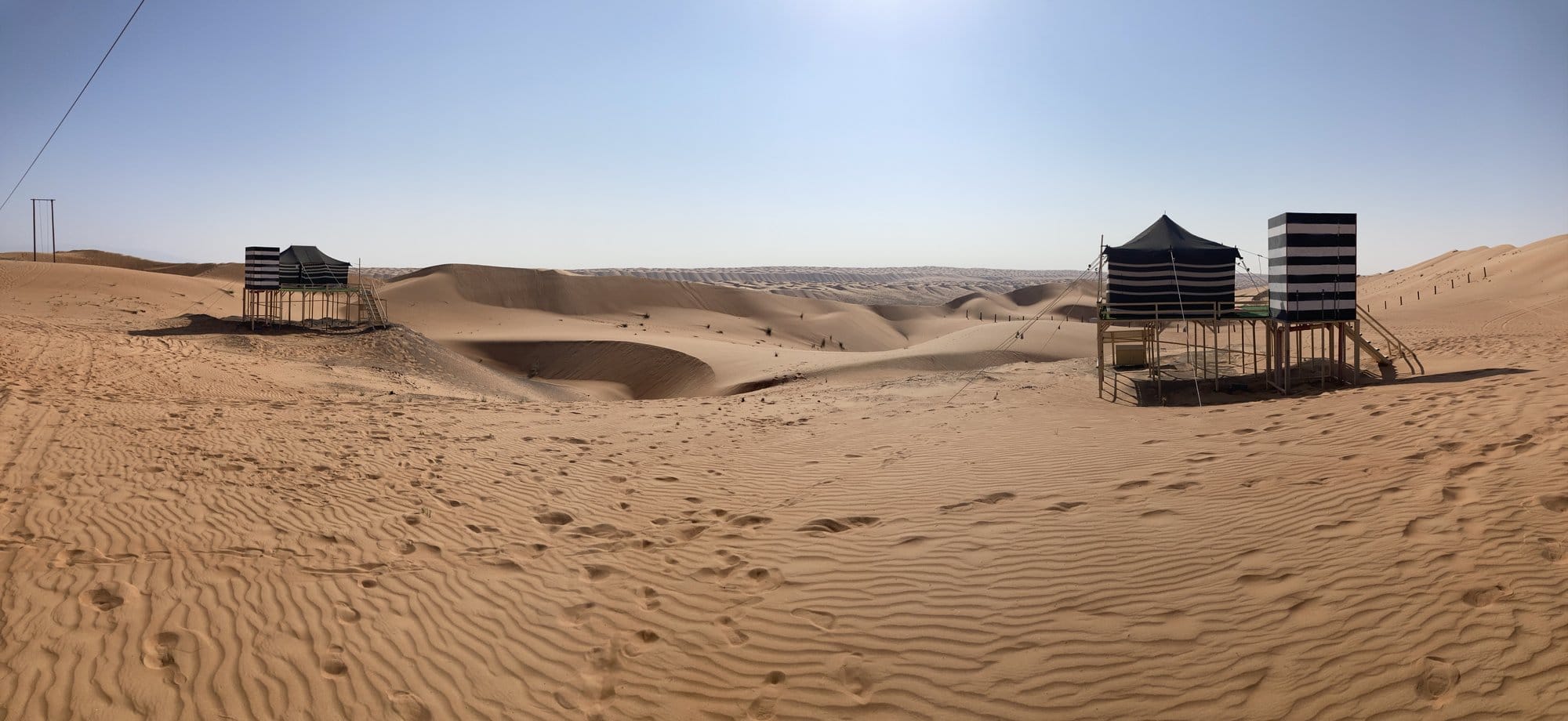
Desert (Wahiba Sands): One night at a Bedouin-style desert camp. These range from basic (shared bathrooms, simple tents) to glamping-level luxury. Ours was mid-range — private tents with en-suite bathrooms, communal dining area with cushions and rugs, and dune access right from the camp. The camp arranged our sand-road transfer.
Coast (Sur): Two nights at a resort hotel right on the beach, which worked as a base for exploring Wadi Tiwi, Wadi Shab, and the local wadis inland. Accommodation options in Sur range from budget guesthouses to beachfront resorts. Waking up to a turquoise sea view after days in the mountains and desert was a proper treat.
Muscat: Three nights to close the trip. We chose a resort along the coast east of the city, in the Qantab/Bandar Jissah area — rocky coves, a private beach, and easy access to the old town and the Grand Mosque. Browse hotels across Muscat to find options that suit your base preferences.
The Mountains: Bahlā', Jebel Akhdar & Nizwá
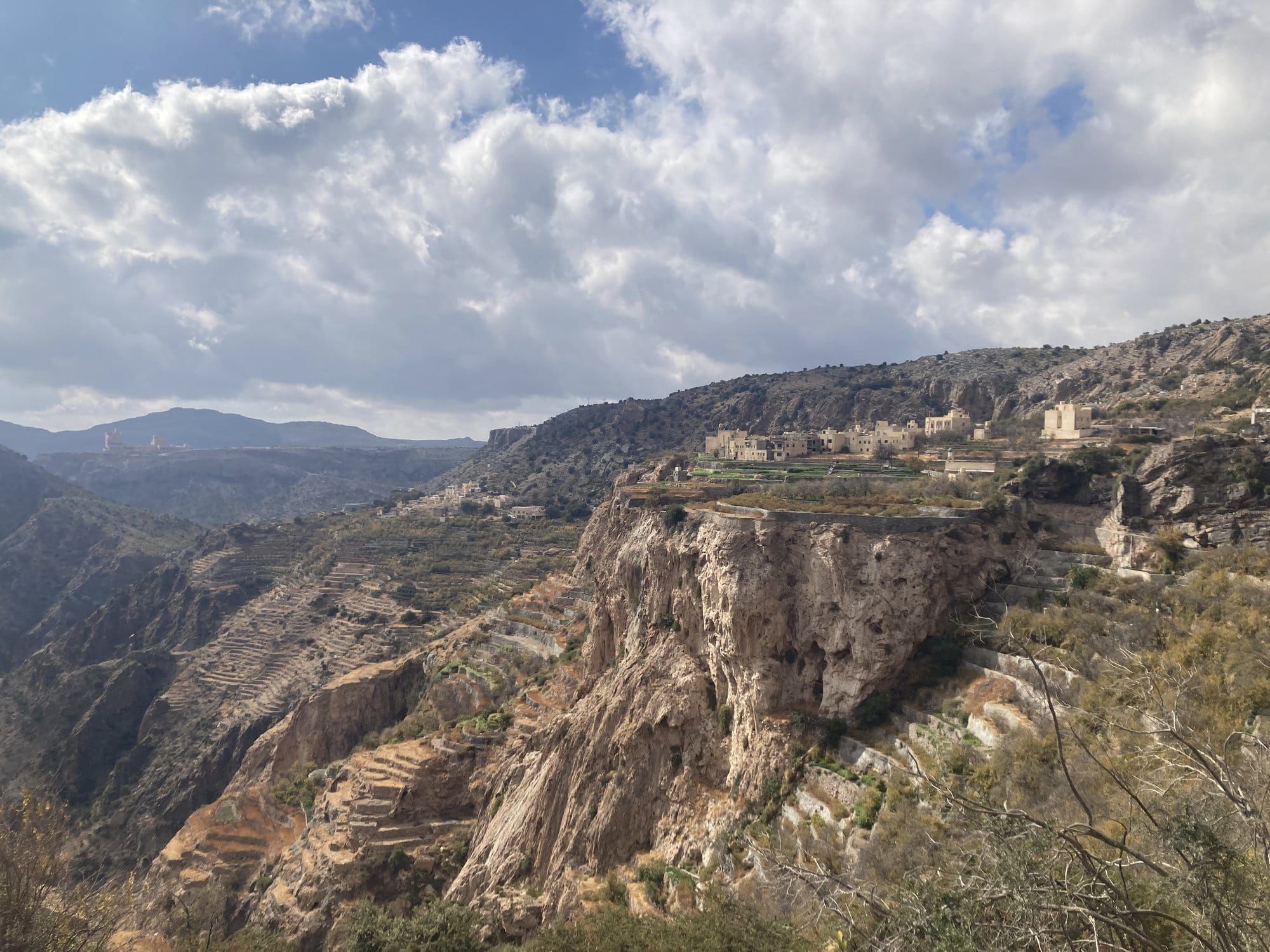
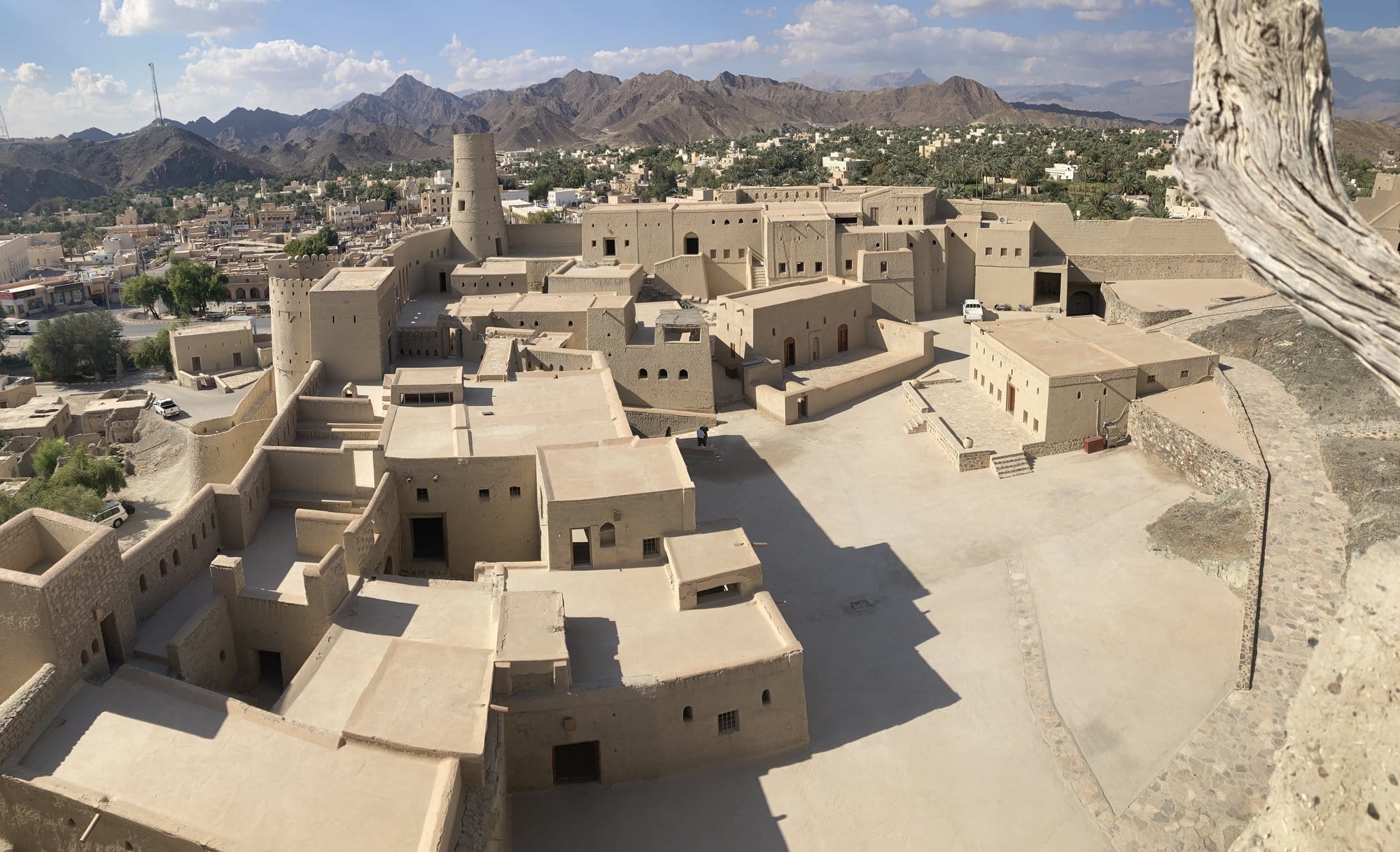
The interior opened the trip. We drove inland from Muscat on 21 December 2022, the coastal scrub thinning into bare rock within an hour, and by mid-morning we were parked above Misfat al Abriyyin watching a stone village tucked against a cliff face above its own palm grove. From there the road climbs into the Al Hajar range, and by afternoon we were looking down on Bahla Fort (around midday) — the UNESCO-listed mud-brick fortress whose ramparts we climbed for a panorama over the ochre town below.
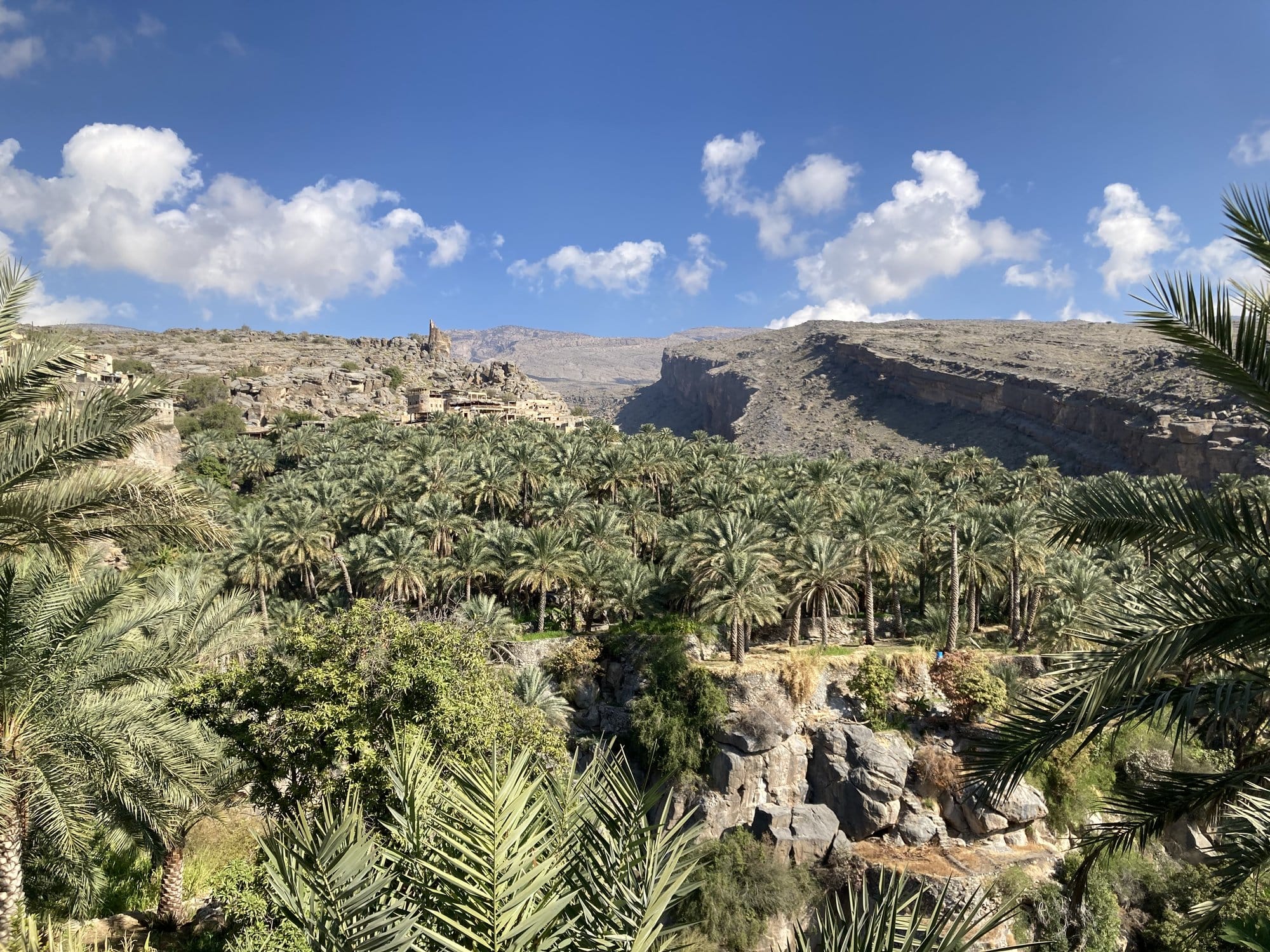
Misfat al Abriyyin is a village that looks like it hasn't changed in 500 years — stone houses stacked up a cliff face, with a falaj (ancient irrigation channel) running through a palm grove below. We walked the stone paths for an hour, the kids scrambling ahead while we tried to photograph every angle. In a nearby village, we watched a woman making traditional bread on a stone oven — one of those travel moments you can't manufacture.
The Jebel Akhdar plateau sits at around 1,920 metres (my watch read 1920 m around midday on 22 December) and the canyon views from the edge are the kind you only get in the American Southwest or here. We parked where the road ends, walked to the lip, and sat on the rock with nothing between us and a kilometre of empty air down to the wadi floor. Later, at 17:05 from the belvédère at Bayt al 'Awābī, the sun dropped directly into the canyon mouth and the whole gorge went gold for about ten minutes.
Bahla Fort, a UNESCO World Heritage site, is a massive mudbrick fortress that you can climb to the top of for panoramic views over the town. And Nizwá itself has a souk, a fort with a famous round tower, and a Friday cattle market that's pure chaos.
The Desert: Wahiba Sands
From the mountains, we drove east and south into the Wahiba Sands (also called Sharqiya Sands), arriving in the late afternoon just as the light turned golden. The transition is sudden — you're on a normal highway, and then the dunes start, and within minutes you're in a sea of orange sand that goes on forever.
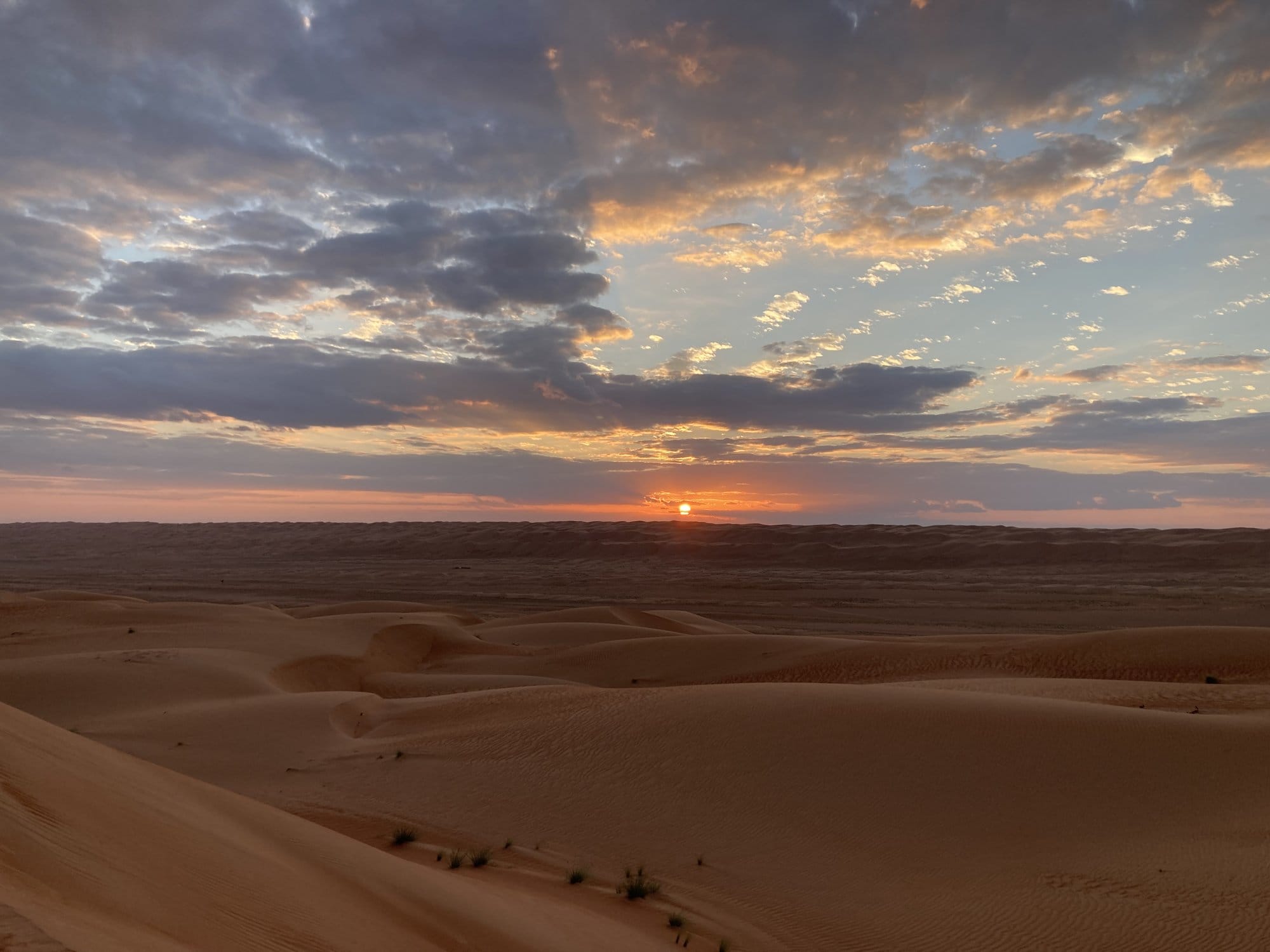
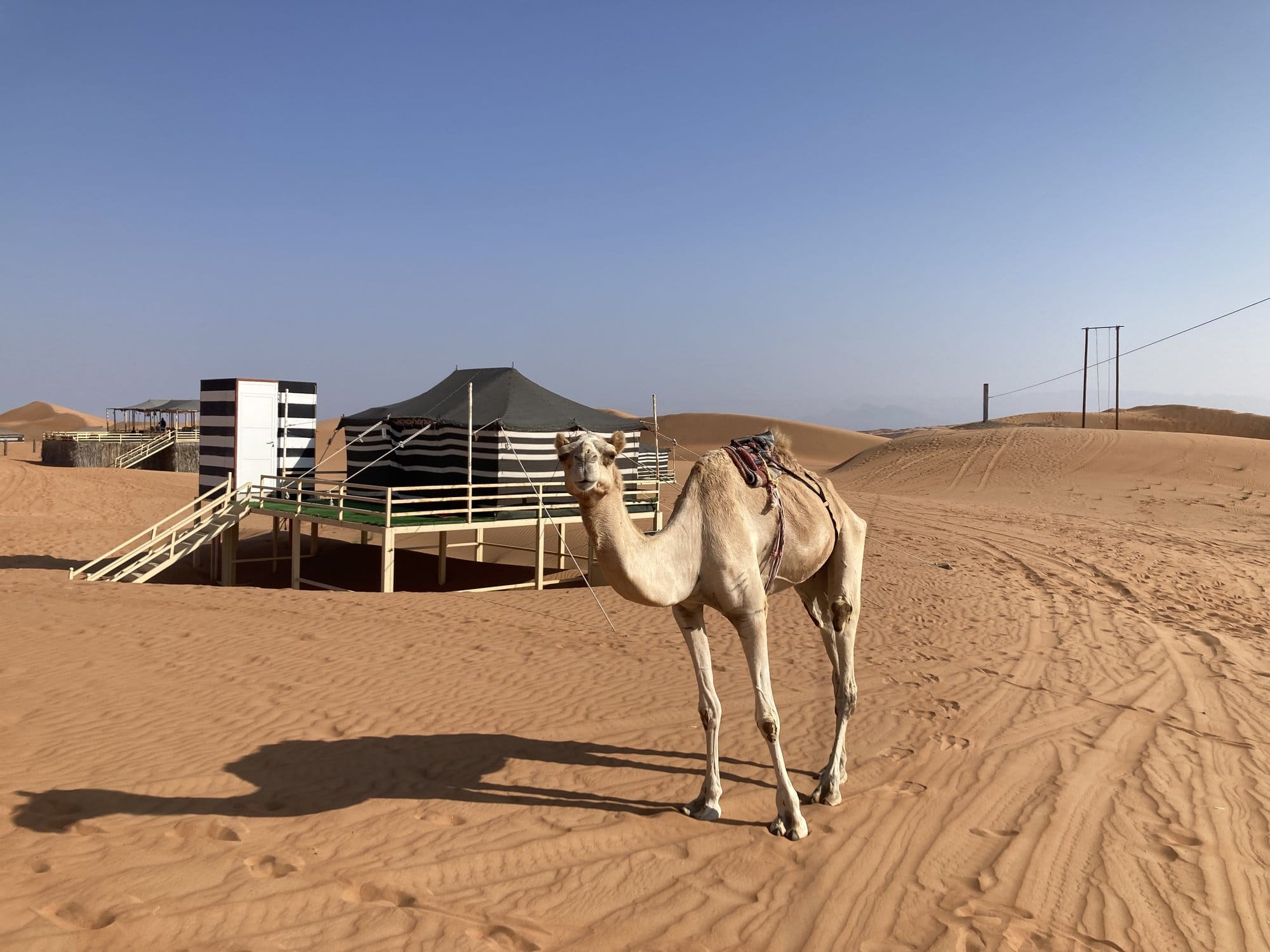
We reached the dunes in the late afternoon on Christmas Eve, climbed the nearest crest on foot, and had the whole horizon to ourselves as the light dropped — 17:08 to 17:23, pastel orange to deep rose, not another soul visible. Early on Christmas morning our youngest was jumping off a dune ridge in the first slanting light; soon after, our Suzuki had sunk a wheel into a soft patch and we were digging it out with the camp's shovel (selfie obligatoire). A camel ambled past the camp gate around 09:42 as if on its way to somewhere important.
The desert camp was a highlight for the whole family. Simple but atmospheric — sleeping in tents with the stars overhead, sitting on cushions for dinner, and the absolute silence at night once the generator switched off.
The Wadis: Tiwi, Shab & Bani Khalid
If the desert was the Christmas postcard, the wadis were the photographic payload. Oman's wadis are river canyons — dry at the mouth for most of the year, but holding permanent emerald-green pools deeper in, where the canyon narrows. You walk in on a dry bed, then scramble, then swim, and by the third pool you're in water chest-deep with canyon walls closing overhead.
We visited three wadis over four days, and each was different:
Wadi Bani Khalid was the first, on Christmas afternoon (13:37 arrival on 25 December) after driving out of the desert. A rocky approach drops you between polished boulders to a deep turquoise basin, and there's a rope swing someone has rigged over the main pool. Our kids were in the water within ninety seconds. Pass the main pool and a narrow passage opens into a second basin — quieter, with a small natural arch overhead.
Wadi Tiwi on 26 December was the most spectacular of the three. The winding road drops from the highway around midday into a valley of date palms and terraced fields; by midday we were using chains bolted into the rock to descend to pool level. We swam through a narrow gorge around midday with mossy fougères capillaires growing on the overhanging walls, and by mid-afternoon we were at the cave — stalactites hanging in a vertical rideau over a blue basin with a waterfall curtain at the back. This was the day the kids talked about for weeks afterwards.
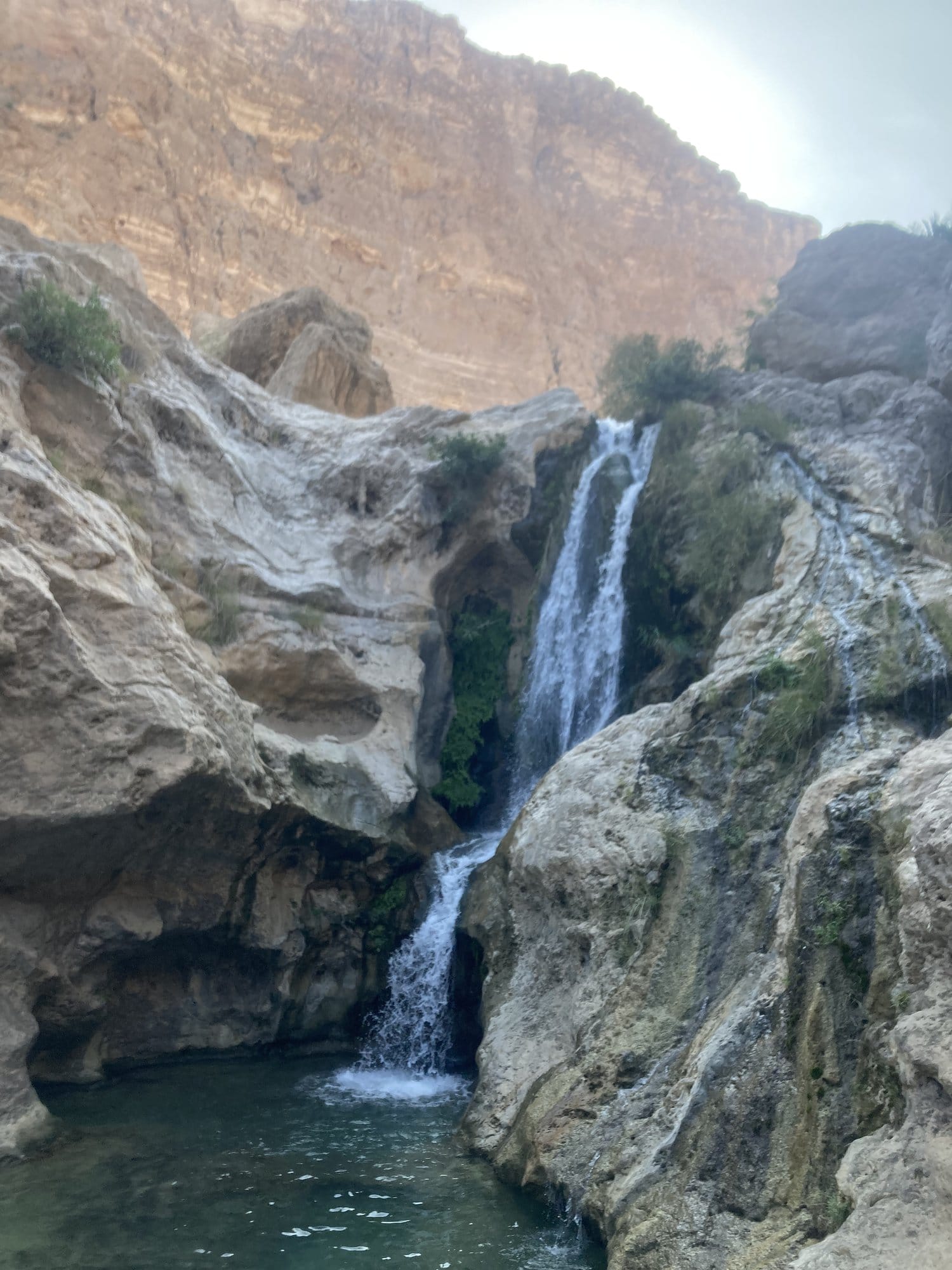
Wadi Shab is the most popular of the three and probably the most beautiful for pure scenery. We were in by mid-morning on 27 December, walking under date palms and past a papaya tree loaded with green fruit, and by 10:42 the canyon had opened into the first of a sequence of emerald pools between massive limestone walls. At 11:35, at the deepest gorge we reached, I could see the white stones on the bottom at about three metres down.
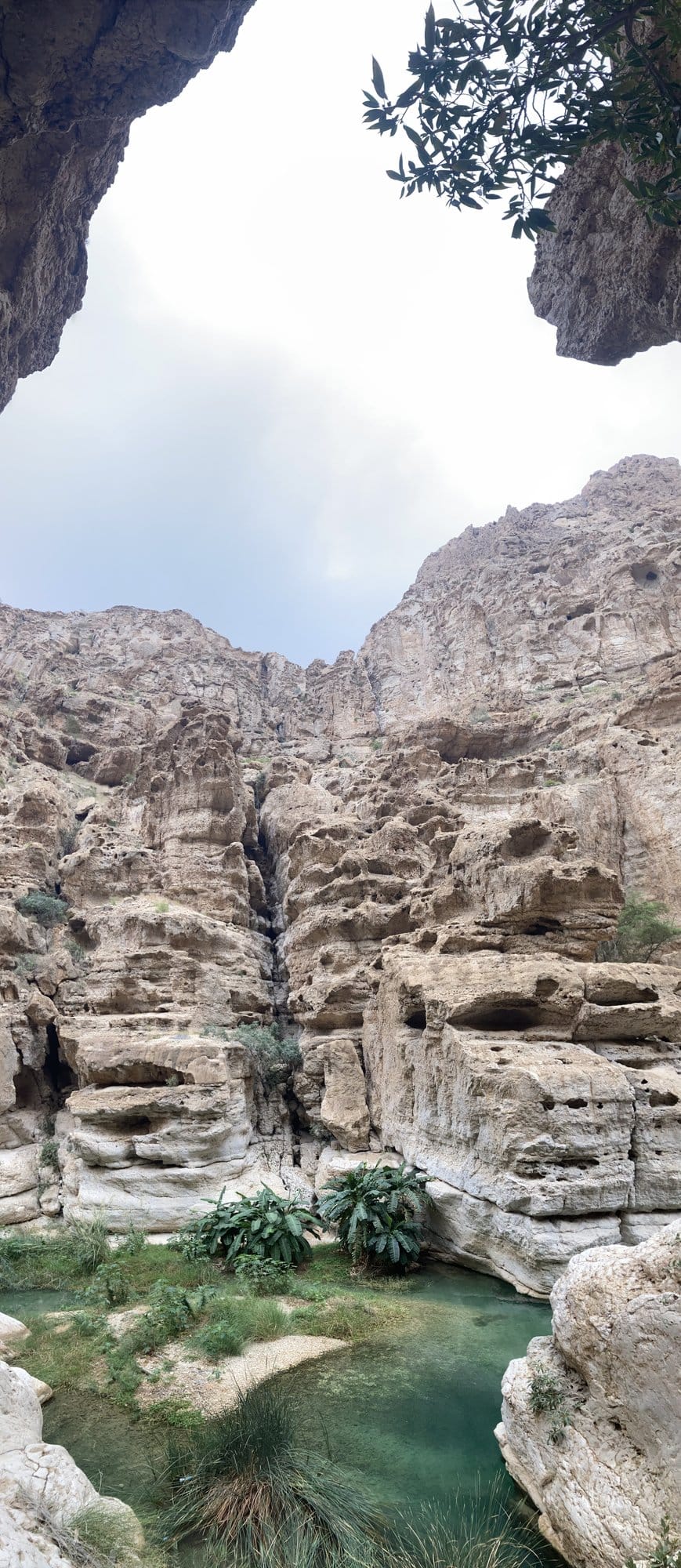
We also explored a less-visited wadi inland from Sur — all white rock formations, turquoise pools, and not another tourist in sight. That's the beauty of Oman: even the famous wadis aren't overcrowded, and the lesser-known ones give you the feeling of genuine discovery.
Muscat: Beaches, Boats & the Grand Mosque
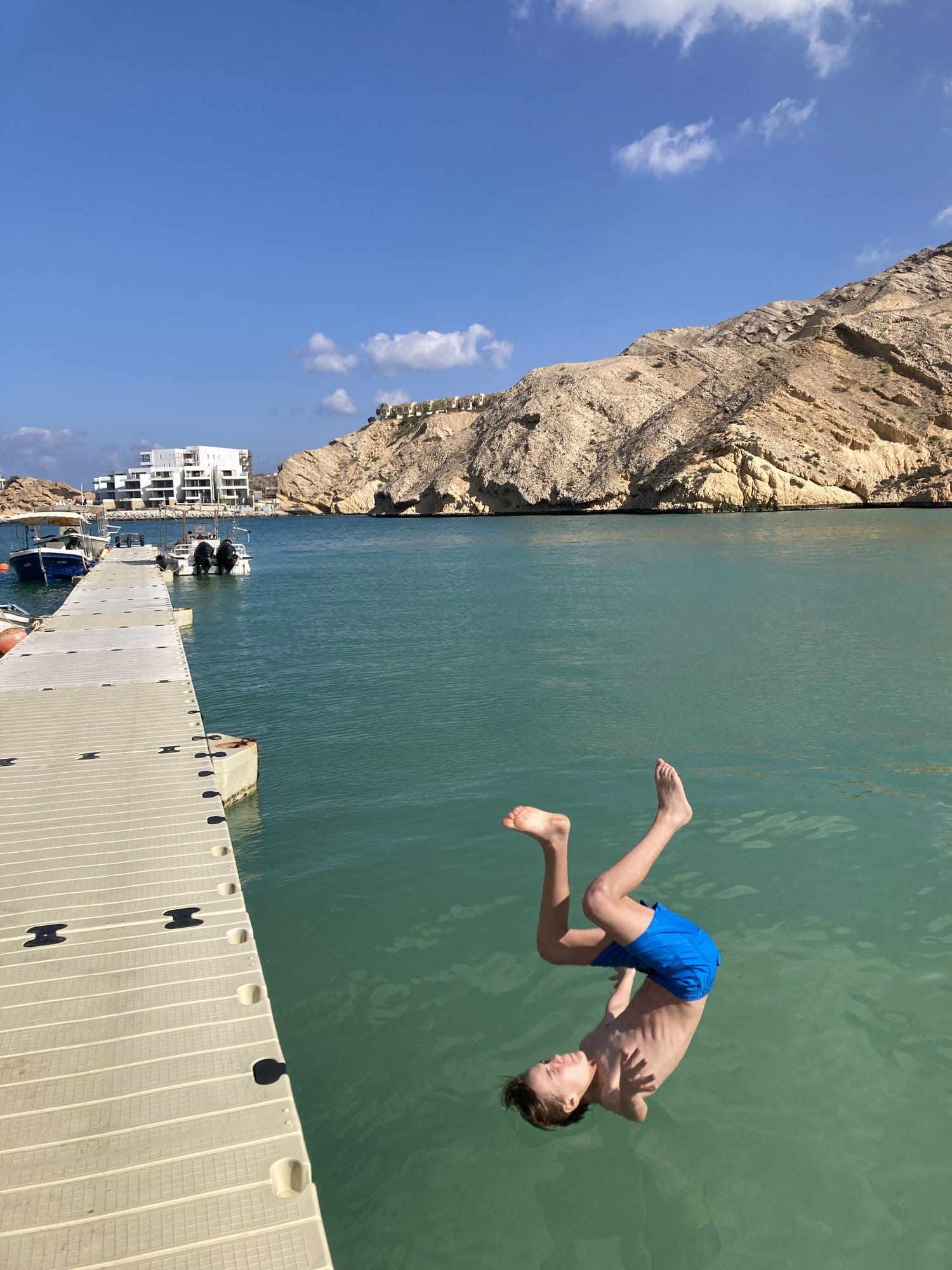
We spent the final three days in Muscat, based at a resort on the Qantab/Bandar Jissah coast east of the city — rocky coves, a private cove beach, easy access to the marina. After the intensity of the desert and the wadis, the pace was earned. Our eldest was doing backflips off the marina pontoon around midday on 29 December while the youngest dared each attempt from the water; a glass of Moët on the beach at 14:33 was the other photograph from that afternoon (it was New Year's, more or less).
On New Year's Eve, we took a boat trip along the coast — rocky headlands, turquoise coves, and that particular quality of Omani coastal light that makes everything look like a postcard.
The trip's cultural close came on 1 January 2023: the Sultan Qaboos Grand Mosque in Bawshar, entered at 10:20 and walked through from courtyard to prayer hall to gardens over the next thirty-six minutes. The main prayer hall holds one of the world's largest handwoven carpets — a single Persian weave in deep blue — and a chandelier that hangs in a crystal column overhead. The exterior is uncompromising white marble and geometric precision; by 10:48 the golden dome was catching direct sun against a cloudless sky. The kids were quieter inside this building than anywhere else on the trip.
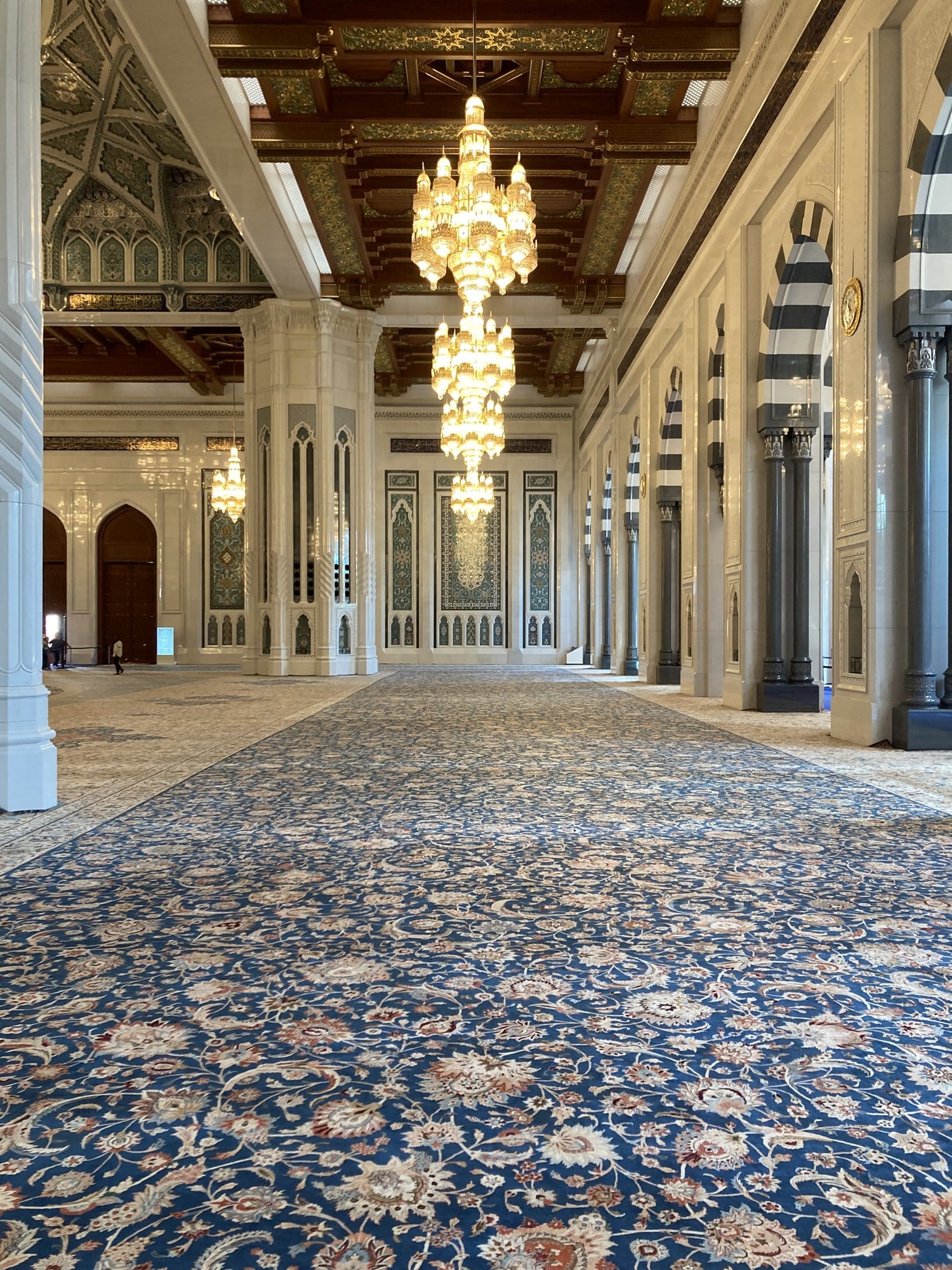
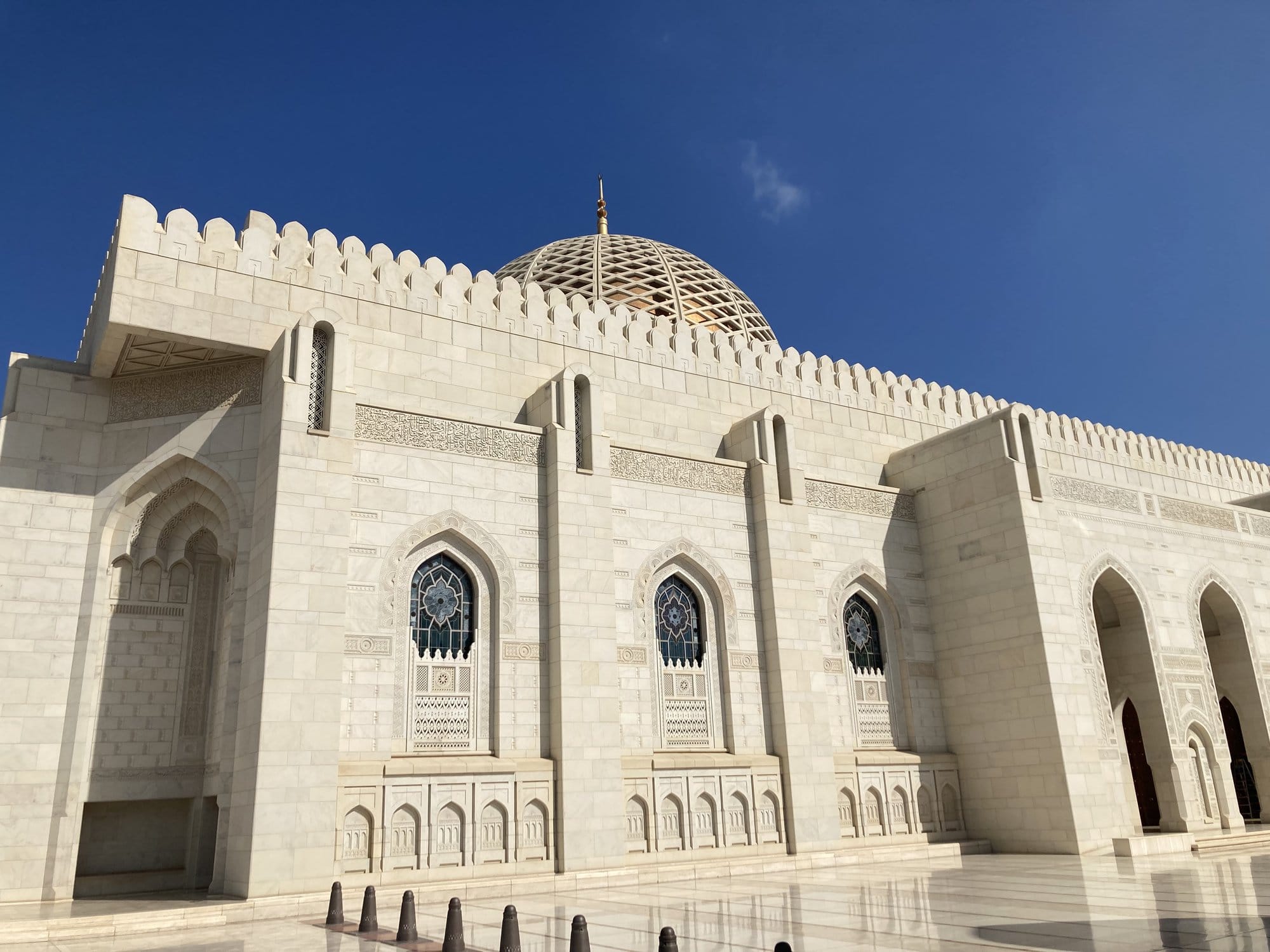
The mosque is free to visit, open to non-Muslims in the mornings, and genuinely welcoming. Dress modestly (women need a headscarf, available to borrow at the entrance). We spent about an hour and could have stayed longer.
Budget
Oman is mid-range by Gulf standards and excellent value compared to its neighbours. Here's roughly what we spent for a family of four over 12 days:
compare flights ~€1,800 return for four (Paris–Muscat, booked 3 months ahead) Car rental: ~€500 for 12 days (mid-size SUV, airport pickup/return) Fuel: ~€50 total Accommodation: ~€1,500 total (mix of guesthouses, desert camp, beach resort, city resort) Food: ~€600 (restaurants plus a few self-catered meals) Activities: ~€200 (fort entries, mosque is free, wadis are free)
Total: roughly €4,650 for 12 days — about €390/day for four people. Comparable to a mid-range European holiday, but with an experience level that's hard to match.
Practical Tips
Visa: Many nationalities can get a visa on arrival or an e-visa. Check current requirements before travel.
Language: Arabic is the official language, but English is widely spoken in hotels, restaurants, and tourist areas. We never had a communication problem.
Driving: Right-hand side. Speed cameras everywhere. Google Maps works perfectly. Petrol stations are frequent along main routes.
Water: Tap water is safe in cities but most people drink bottled. Keep plenty of water in the car — we went through several litres a day hiking wadis.
What to pack: Swimwear for wadis, hiking shoes with grip (wadi rocks are slippery), modest clothing for mosque visits, warm layers for desert nights and mountain mornings, sunscreen.
Mobile data: We bought a local SIM at the airport for about €10 with good data allowance. Coverage was excellent even in the mountains and desert.
Safety: Oman is one of the safest countries in the Middle East. We never felt anything but welcome, including as a family with young children. Petty crime is extremely rare.
Suggested Itinerary (12 Days)
Day 1: Fly into Muscat, pick up rental car, drive to Nizwá area (~2 hours). Settle in.
Day 2: Misfat al Abriyyin village (morning), Bahla Fort (afternoon).
Day 3: Jebel Akhdar mountain drive and canyon viewpoints. Return to Nizwá for the souk.
Day 4: Drive to Wahiba Sands (~3 hours). Arrive at desert camp mid-afternoon. Sunset on the dunes.
Day 5: Sunrise at camp, morning in the desert. Drive to Wadi Bani Khalid (~1.5 hours) for afternoon swim. Continue to Sur (~1.5 hours).
Day 6: Wadi Tiwi — full day exploration with chain scrambles and swimming.
Day 7: Wadi Shab — morning hike and swim. Afternoon at the beach.
Day 8: Morning at the hotel. Drive to a lesser-known inland wadi. Afternoon beach or relax.
Day 9: Drive to Muscat (~2.5 hours). Check into resort. Beach afternoon.
Day 10: Free day — marina, boat trip, or explore Mutrah Souk in old Muscat.
Day 11: Sultan Qaboos Grand Mosque (morning). Afternoon at the beach. Evening at leisure.
Day 12: Return car, fly home.
This was roughly our itinerary and it covered everything without feeling rushed. With only one week, prioritise the desert (2 nights), one wadi (Wadi Tiwi or Shab), and the mosque.
Pierrick drove an Oman loop with his family of four for twelve days from 21 December 2022 to 1 January 2023, with children then aged 9 and 13. The three moments he mentions when people ask where to start: Christmas-morning silence at 07:01 on a Wahiba Sands dune, the chained descent into Wadi Tiwi at 13:22 on 26 December, and walking across the Persian carpet under the dome of the Sultan Qaboos Grand Mosque on New Year's Day 2023. More about his approach on the About page.
Final Thoughts
Oman was, in the end, the best family trip we had done in years. The landscapes are world-class and still quietly off most European radar; the driving is easier than any Mediterranean country we've crossed; and the mosque and the Bedouin camp bracket the cultural range of the trip. If I had to choose the three moments to defend it on, they would be: the Christmas-morning silence in the mid-morning on the dunes before the camp woke up, the chained descent into Wadi Tiwi around midday on 26 December, and the first footstep onto the Persian carpet under the dome on 1 January.
We came expecting a nice holiday and left feeling like we'd discovered somewhere truly special. The kids still rank the Wahiba Sands and Wadi Tiwi among their all-time travel highlights, and the Grand Mosque is one of the most beautiful buildings any of us have ever seen.
If you're looking for something different for a winter family trip — something beyond the usual European or Southeast Asian circuit — put Oman on the list. It deserves to be much better known.